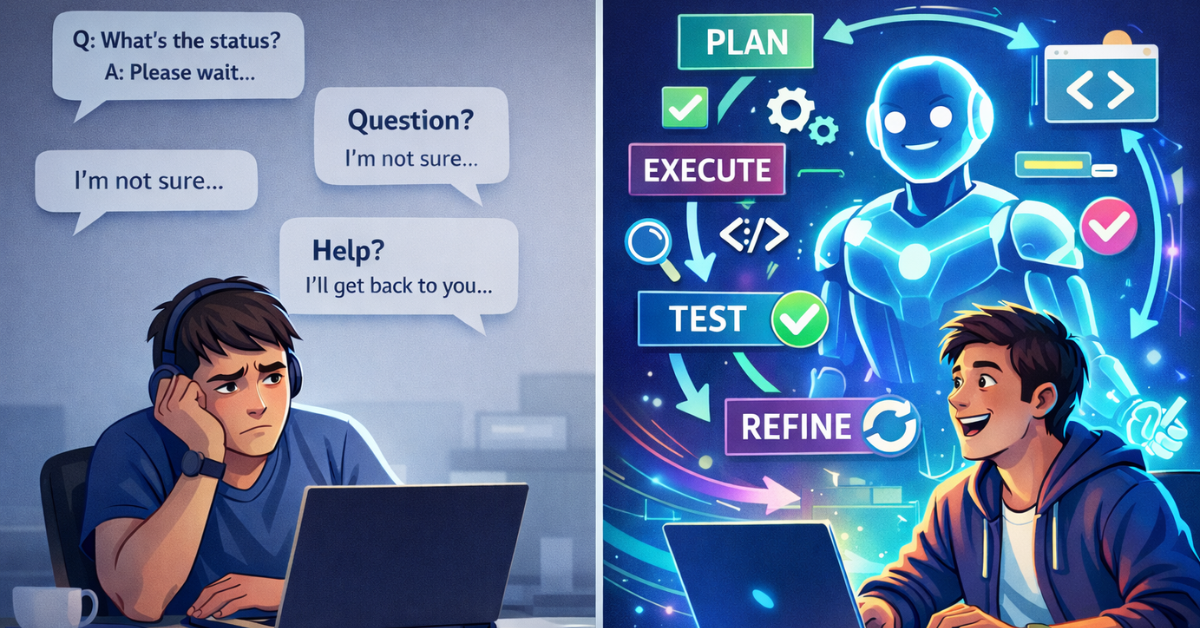

I’ll be honest: for a long time, I thought AI chatbots were impressive but ultimately limited. Useful for answering questions, maybe helping debug a line of code, but nothing revolutionary. They felt reactive. You asked, they answered. End of story.
Table of Contents
Then I tried an AI agent.
Not a chatbot. Not a fancy autocomplete tool. An agent that could plan, execute, make decisions, correct itself, and keep going without me holding its hand every step of the way. That was the moment my assumptions quietly fell apart. What I saw felt less like “chatting with AI” and more like working alongside a junior developer who never got tired.
This post is my attempt to unpack that moment, what AI agents actually are, how I tested them, and why I think this shift matters far more than most people realize.
Why This Feels Different From Chatbots
Chatbots wait for instructions. AI agents don’t.
That’s the simplest way I can explain the difference. Traditional chatbots respond to prompts one at a time. AI agents, on the other hand, can take a goal like “build a small web app,” break it into tasks, execute those tasks in sequence, check the results, and adjust their approach if something fails.
The first time I saw this happen, it genuinely felt like magic. I wasn’t asking “what should I do next?” The agent was deciding that on its own.
What Are AI Agents, Really?
In simple terms, an AI agent is an AI system designed to:
- Understand a high-level goal
- Plan multiple steps to achieve that goal
- Use tools (code execution, APIs, browsers, files)
- Evaluate progress and self-correct
- Continue until the task is complete
Unlike chatbots, agents have memory, reasoning loops, and autonomy. Many modern agent frameworks use large language models combined with planners, tool-calling systems, and feedback mechanisms.
Research backs this up. According to recent industry reports, task-oriented AI systems can reduce time spent on complex workflows by 30–60% in software and operations roles, depending on task complexity. That’s not hype. That’s measurable productivity.
How I Tried AI Agents (Hands-On Experience)
I didn’t start with anything fancy. I gave an AI agent a practical developer task:
“Create a basic full-stack web app with authentication and a simple dashboard.”
What surprised me wasn’t the final output. It was the process.
The agent:
- Planned the app structure
- Chose a tech stack
- Created backend routes
- Built frontend pages
- Detected a broken API call
- Fixed it without me pointing it out
I remember sitting there thinking, “I didn’t tell it to debug that.” It just… did. That was the moment this stopped feeling like a tool and started feeling like collaboration.
A Simple Step-by-Step Example of an AI Agent at Work
Here’s a simplified version of how an AI agent operates behind the scenes:
- Goal given: “Build a portfolio website”
- Planning phase: Decide pages, layout, and features
- Execution: Generate HTML, CSS, JavaScript
- Testing: Check for errors or broken layouts
- Correction: Fix issues it detects
- Iteration: Improve styling or performance
- Completion: Deliver a working result
That loop is the key difference. Chatbots stop after step 3. Agents keep looping until the job is actually done.
Why This Shift Matters for Productivity and Jobs
This is where things get serious.
AI agents aren’t just speeding up tasks. They’re changing how work gets done. Developers can focus more on system design and creative decisions while agents handle repetitive setup. Non-technical users can automate workflows that previously required entire teams.
Studies already show that developers using AI-assisted tools complete tasks faster with fewer errors. With agents, that efficiency compounds because the AI doesn’t stop at suggestions. It executes.
Of course, this raises job concerns. Some roles will change. Some tasks will disappear. But history shows that automation tends to shift jobs, not erase ambition. The developers who learn to work with agents will be far more powerful than those who ignore them.
The Limitations No One Should Ignore
This isn’t a fairy tale.
AI agents can:
- Make confident but incorrect decisions
- Misunderstand vague goals
- Get stuck in inefficient loops
- Produce insecure or unoptimized code
They still need human oversight. I’ve had agents generate code that worked but wasn’t safe or scalable. Treating them as “set and forget” systems is risky. Right now, they are powerful assistants, not replacements for human judgment.
How to Get Started With AI Agents Today
If you’re curious, start small:
- Experiment with agent-based coding assistants
- Try automating a personal workflow (file organization, data scraping, report generation)
- Study how planning and tool-calling works in modern AI systems
- Focus on understanding the logic, not just the output
You don’t need to be an expert. You just need curiosity and a willingness to test, break things, and learn.
Looking Ahead: Why I’m Optimistic (and Cautious)
I genuinely believe we’re at the beginning of a major shift. Moving from chatbots to autonomous AI agents feels like moving from calculators to computers. Subtle at first. Transformative in hindsight.
This excites me not because it replaces humans, but because it amplifies what humans can do. When used responsibly, AI agents can free us from busywork and let us focus on creativity, strategy, and problem-solving.
If you’re a developer, a student, or just someone curious about where technology is going, my advice is simple: don’t sit this one out. Experiment. Observe. Learn.
I’m still early in this journey, but I’m paying close attention. And if you’re curious too, now is the perfect time to start walking this path together.